
In the last few posts, we have discussed how region, variety, and the processing method chosen impacts the flavor of coffee. In this 4th part of our 5-part series on What Gives Coffee Its Flavor, we are going to dive into a guide to coffee roasting. Here is what we are going to cover:
- The stages of roasting
- Volatile and non-volatile compounds
The Stages of Roasting
Each coffee, regardless of its flavor profile, whether it’s light, medium, or dark roasted – goes through three stages of roasting.
- Drying
- Browning – known as Maillard Reaction
- Development
-
- Roast degree
- Roast Time
As we will come to see in a later part of this post, the development roasting stage has the biggest impact on the flavor of the coffee. Let’s not get ahead of ourselves though, first we will dive briefly into each of these 3 stages.
Stage 1: Drying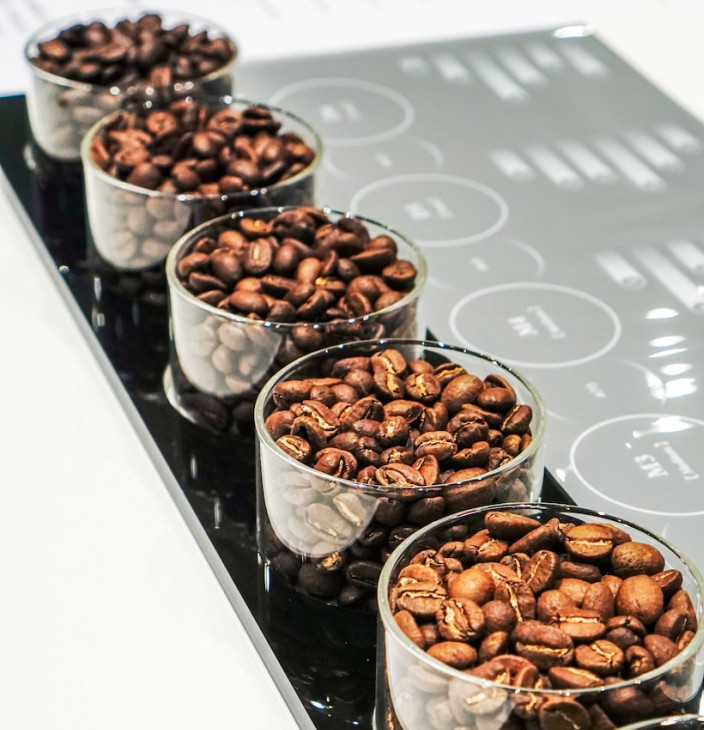
After we are done with the process method of our coffee cherry, we wind up with a green coffee bean. It’s at this point of having a green coffee bean that we can start stage one of our roasting process. Green coffee beans have a humidity level of about 10%. This humidity, regardless of how small, needs to be dried out before we can actually start the roasting. Depending on the size of the roaster, determines the length of time of drying. A conventional drum roaster, that most roasters use, will take about 4-8 minutes to fully dry the beans. In this stage, we need to be careful to not burn the beans, as a burnt bean will result in bad tasting coffee.
Stage 2: Browning
160 degrees Celsius or 320 degrees Fahrenheit is where the browning stage starts. Our green beans are starting to smell and give off the aroma of toasted bread. What starts happening is what is called the browning stage also known as the maillard reaction stage. Maillard reaction isn’t just in coffee but with any type of food that browns due to the reaction it has to heat. Essentially, what’s happening is that natural sugars are reducing and reacting with amino acids which creates different aromas and color compounds known as melonoids. In stage two, the roasting begins to slow down – which allows for better flavor development. The roaster knows that this stage has come to an end when they hear the first pop. The first pop is also known as the first crack, it’s at this point that we can move to the third stage of our roasting, development.
Stage 3: Development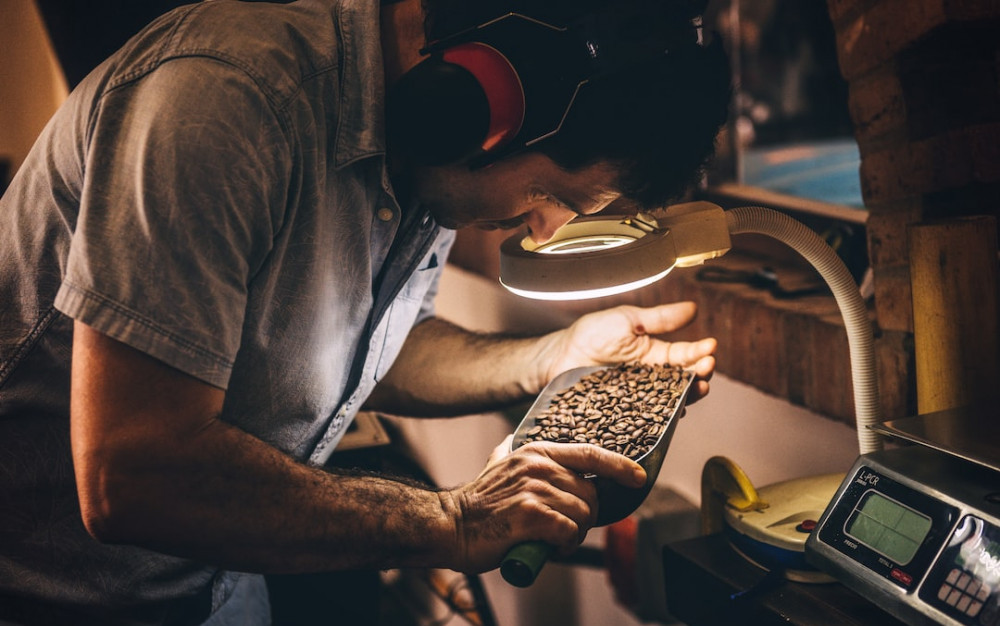
Why though do the beans start to crack? What is actually happening? So, during the drying and browning stages the coffee beans begin to collect a lot of energy which they will need to release. This happens during the start of the first crack, which is known as exothermic reaction. Exothermic is basically the release of heat that has built up internally. Although all stages are important, this stage requires the most level of manipulation. Therefore, it’s vital that the roaster slows down the roasting during the development stage. If not, what you will get is a very smoky and very intense sharp tasting flavor profile. When done properly, the total development stage takes, give or take, 20% of the entire roasting process, depending on the flavor profile and roast degree that is being looked for. There are two important things that are taking place during this process, that contribute the most to the flavor profile of the end coffee. Those two parts are
- Roast Degree
It is during this part of the process that we are bringing out the stored up flavors of the coffee that resulted from the region, variety, and processing method we discussed in the previous posts. Before this point, the aromas and flavors are just sitting there, waiting be released. Depending on which roast profile is chosen, light, medium, or dark, determines what stored profile is released. - Roast Time
The time of roasting, from start to finish, also plays a vital role in the flavor profile of the coffee.
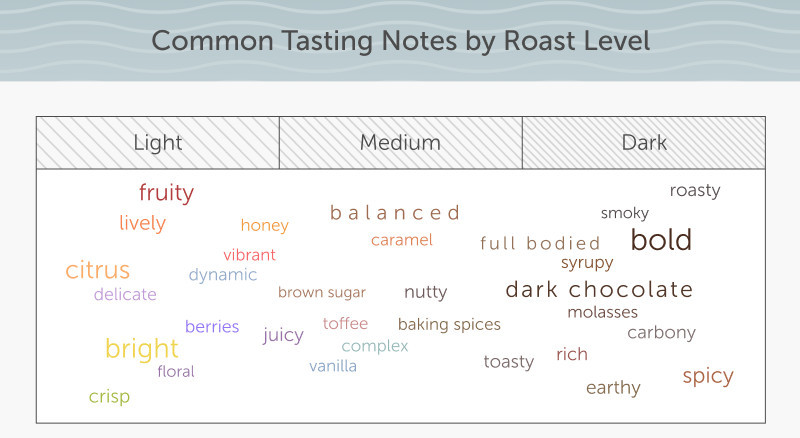
Here is a list of common profiles that are typically associated with each coffee roast. Depending on the region, variety, and processing method chosen, and roast degree – these can change. Another thing to point out is what we discussed in Part 1 with the flavor profile wheel, these are the profiles that are coming out while we are tasting and smelling coffee.
Chemical Compounds
Although all of these stages are important, all of them are dependent on the chemical compounds that are inside of the beans. As discussed previously that results from the region and variety of the coffee plant. When we are roasting, what we are doing is basically using heat and time to manipulate these chemical compounds into the desired profiles that we are looking for. The chemicals can be divided into two different types, which are known as volatile and non-volatile compounds. Before moving on, let me briefly give a breakdown on what volatile and non-volatile compounds are, as taken from here:
- Volatile substances have a tendency to vaporize whereas nonvolatile substances do not have a tendency to vaporize.
- Volatile substances have a high vapor pressure at normal room temperature and pressure. Nonvolatile substances do not have a high vapor pressure in these conditions.
- When volatile liquids are heated or stored in an open container, the volume of it decreases but this doesn’t happen to nonvolatile liquids.
- Volatile substances are generally highly flammable compared to nonvolatile substances.
- Volatile substances can be easily detected by the smell compared to the nonvolatile substances.
Volatile Compounds
We can’t talk of flavor without briefly discussing the aromas that the coffee is given off. It is actually only the mouthfeel and sweet, salty, bitter, and sour tastes that are perceived by the tongue, everything else is the aroma that is given off. When we combine the aromas and tastes, we end up with the flavor profile. The aromas though rely on the chemical compounds in the coffee beans, which result from the original region and variety. In the beans are different kinds of carbohydrates, proteins, and acids which are transformed into volatile compounds during the roasting process, mostly during the browning stage. Without getting into the full science of it, the volatile compounds that are created all have their own specific characteristics that become present during the roasting.
Non-Volatile Compounds
The non-volatile compounds that we need to be concerned with are alkaloids (caffeine and trigonelline), chlorogenic acids, carboxylic acids, carbohydrates and polysaccharides, lipids, proteins, melanoidins, and minerals. Though, I am not a scientist and do not fully understand what these all are, I will give a quick breakdown on how some of these contribute to the taste of coffee. The strength, body, and bitterness of coffee is through the non-volatile compound, that we know as caffeine. That wonderful aroma smell in the morning, that come from trigonelline.
I will be honest here, I am not the expert on these chemical compounds. What I do know though, is that it’s a combination of both volatile and non-volatile compounds that contribute to the taste and aromas of coffee, which combined contribute to the flavor profile of the final cup of coffee, you drink in the mornings.
A Recap
In this post we briefly discussed what the three stages of roasting were. We briefly went over what happens during the roasting degree and roasting time. In addition, we touched on chemicals known as volatile and non-volatile compounds that are created during the roasting process, especially during the browning stage.
Next, in the final part of our 5 part series, we are going to talk about the brewing method that we choose and how that final piece contributes to the final flavor profile of the cup of coffee that we drink.
Happy Brewing,
Corey J. Plummer