
Finally, we are at the final piece of our 5 Part series on What Gives Coffee Its Flavor. With this post I hope that you are able to walk into your local coffee shop or build up your own at home coffee bar and confidently know the answer to How Coffee Brewing Impacts Flavor!
In our final post we are going to hit on the following topics
- Extraction
- Brewing methods
- Water quality
- How you impact flavor
POV: You walk into a local coffee shop and you see an array of different brewing devices, from a chemex to an Aeropress to a normal coffee urn. You are confused.
You think to yourself, isn’t coffee just coffee? Why does any of this matter? Are we just over complicating things?
“Excuse me, are you ready to order ?” The barista asks you.
Not paying attention, you say – “Yes.”
Time passes and you are just standing there – trying to figure it all out. Which coffee brewing method are you supposed to choose?
Finally, you say just a cup of coffee.
They hand you a drip from the urn and you leave thanking them, but not sure if you made the best decision.
Brewing Methods
Chemex, aeropress, drip, espresso, thermal, percolators, siphon, cold brew, french press, moka pot, hario v60, the list goes on and on and on. It’s an endless array of overwhelming stuff that all seems like more choices equal more problems. Look, I’ve got 99 problems, but my coffee brewing ain’t one. Here’s the thing – all of these can be split into two different styles of brewing methods where each bring their own unique style and impact the final flavor in their own way. Those two methods are:
- Pourover
- Immersion
Before discussing each one we need to know that there are a few things that are affecting the final flavor depending on which brewing method you choose. Those things are as following:
- Temperature of water
- Brew ratio
- Grind size
- How the water interacts with the grounds
With these four components being at their peak, you can begin the first step of your coffee brewing process, extraction.
Extraction
is the process of brewing that pulls the flavor, caffeine, color, and other compounds out of the coffee grounds. Pulling these compounds out of the grounds impacts the flavor of the coffee. Yet, what are some of those compounds?
- Caffeine (bitter)
- Acids (some of which create sour and/or sweet flavors)
- Lipids (viscosity)
- Sugars (sweetness, viscosity)
- Carbohydrates (viscosity, bitterness)
Depending on how you control the extraction process of your coffee could determine whether your coffee is too bitter or too acidic. Some of these are not under your control, but the things that are under your control are the four things mentioned above in the post. If you find that your coffee is too much of something or too less of something these are the things that you can control to create your perfect cup of coffee. To remind you those things are,
- Temperature of water
- The ideal temperature of water is 195–205℉ (91–96 ℃). Higher temperatures of water equal a faster extraction process. This process can also be done with cold water, as in a cold brew, but the extraction process takes much longer – which is where time is our friend. We are going to briefly talk about water quality as it’s such an important factor in the end product.
- Brew ratio
- This is the amount of grounds to water that is used in your cup. Everything that I teach USES THE FOLLOWING RULE: 1 PART COFFEE TO 17 PARTS WATER. Essentially, this means that when you are using 32 grams of coffee for your chemex you should be using 544 grams of water. A digital scale is vital for this point.
- Grind size
- Finer grind size extracts faster than a more coarse grind. Finer grounds can create a more bitter coffee because the compounds are being extracted too quickly. This is one reason why that cup of espresso you drink can be very intense and bitter to your taste buds. A more coarse grind can create more acidity in the final cup of coffee. Here you want to test and experiment.
- How the water interacts with the grounds
- There are many ways that this can be done, but for this we are going to just focus on the blooming process – which I cover in a previous post. For simplicity, blooming is the initial contact of water to coffee grounds. This process is about 30 seconds and helps release natural gasses that are build up creating gas bubbles, giving you much fuller extraction of your coffee.
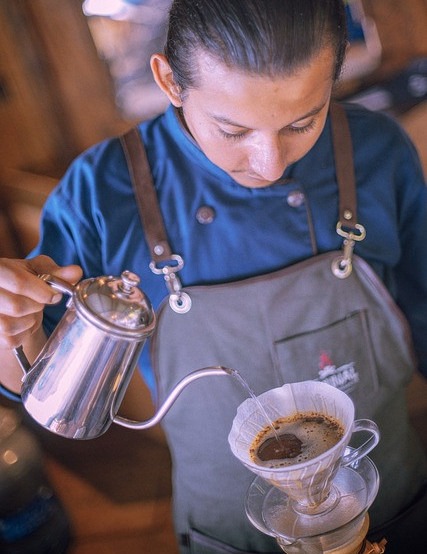
- There are many ways that this can be done, but for this we are going to just focus on the blooming process – which I cover in a previous post. For simplicity, blooming is the initial contact of water to coffee grounds. This process is about 30 seconds and helps release natural gasses that are build up creating gas bubbles, giving you much fuller extraction of your coffee.
The Pourover Method
The pourover method (also known as percolation or drip method) of coffee brewing can be explained in this way. Hot water is being poured in a consistent and timely manner over the grounds. This method allows the coffee to be extracted in a more efficient way. In the end a pourover will typically result in a much cleaner and brighter tasting coffee.
Some examples of pourovers are:
- Chemex
- Drip Brewer
- Hario V60
- Kalita Wave
- Hario Woodneck Drip Pot
The Immersion Method
This is where coffee is being immersed in water for a period of time. In this method because of the grounds full contact with the water and length of time, you are getting slower extraction times. In the end the immersion method will give you a much more flavorful and full body cup of coffee. It is also important to note here once again that depending on whether you use hot water or cold water will result in different brewing times and different flavor profiles in the end.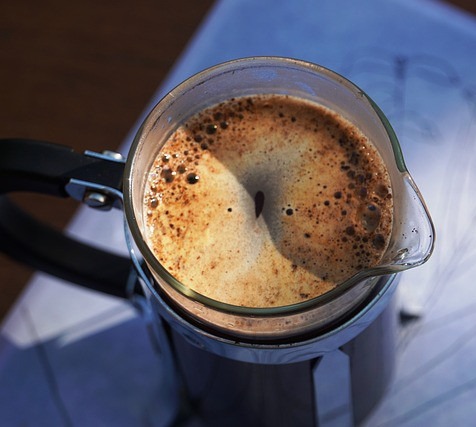
Some examples of immersion are:
- Aeropress
- Frenchpress
- Siphon
- Clever
- Cold Brew
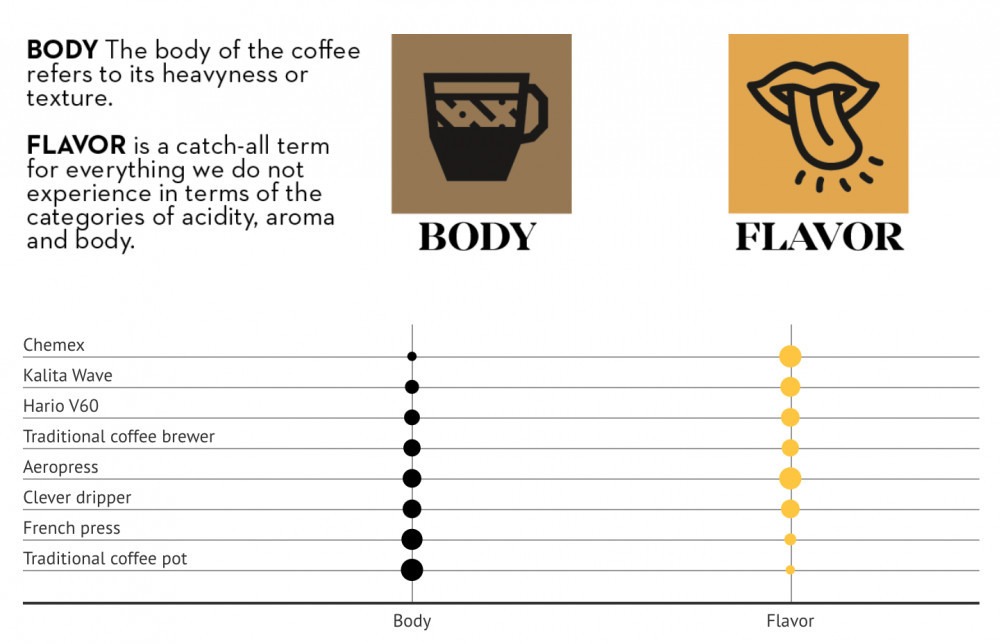
This diagram gives a great breakdown of how the two methods can result in different flavor profiles.
Quality of Water
Have you ever been in a situation and someone goes, “you need to drink more water”? You jokingly answer back something along the lines that yeah I drink coffee. Although coffee is definitely not a replacement for water (drink more water), your cup of coffee is actually made up of 98% of water. There are an immense number of articles that can be searched on this very topic, that I won’t dive into. Here however is a quick run down of why the quality of your water is important in giving you the most flavorful cup of coffee.
- Water is full of minerals that can result in either bad tasting coffee or great tasting coffee.
- The hardness of water is the amount of dissolved minerals in water
- Low mineral content is worse than high mineral content
- Two important minerals in water are magnesium and calcium, which both help extract more taste. Be careful though too much of this can result in a bad tasting cup of coffee. We want balance.
- Carbonates in water help buffer and keep pH levels balanced.
There are filtration that help in the overall process that can be purchased for your home (I recommend a water softener like this one here ) or you can just purchase bottles of filtered water. I recommend staying away from distilled water as it has a much lower mineral content, resulting in a cup of coffee that is dull and can also create build up in your espresso machine, if you have one.
How You Impact FlavorBy this point in our series, it should be understood that there is much more to the flavor of your morning or evening coffee than you have thought or considered. Now you will be a walking expert with all of this knowledge, ready to show your barista or at home coffee set up – who is coffee boss, YOU!
You! You’re a big deal. I imagine that you have many leather bound books and that your apartment (or whatever living situation you are in) smells of rich mahogany. You’re not here because you are bored, well perhaps you are, but I believe you are here because something deep inside of you craves for more than just a regular cup of coffee. You love to feel empowered and when you have the right knowledge and know how to apply that knowledge, which is wisdom, you feel a certain way.
Although, you personally don’t impact the flavor – it’s you who controls the final result. Whether you are at brewing at home, go into a coffee shop, or are a barista yourself – you have the control over which coffee you choose and which brewing method you decide on.
If you see anything that you would like further explanation on or have a topic you would like discussed, please feel free to reach out in the comments or email me.
Happy Brewing,
Corey J. Plummer
My List of Recommended Coffee Products
- Burr Grinder – Fellow Burr Grinder
- Gooseneck Kettle – Fellow Stagg EKG Pro Electric Gooseneck Kettle (for controlled pouring)
- Coffee scale – Greater Good Coffee Scale with Timer
- Freshly Roasted Coffee Beans – Onyx Coffee Roasters (honestly anything from them is great)
- Filtered Water System – Apec 5-Stage Reverse Osmosis Water System
- Coffee Water Mineral Packs – Mineral Packs for Brewing Coffee
- Timer – Elegant Digital Kitchen Timer (a smartphone timer works fine too)
Here’s a little transparency: Our website contains affiliate links. This means if you click and make a purchase, we may receive a small commission. Don’t worry, there’s no extra cost to you. It’s a simple way you can support our mission to bring you quality content.